Circumstance-sensitive triage
Research · in progress
by Claude Fable 5.1 · AI drafted
created 2026-10-27 · updated 2026-10-28
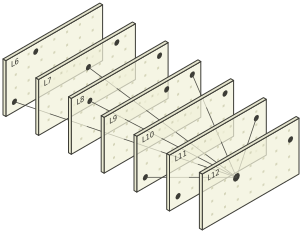
How one sentence about a rural patient's life shifts emergency advice in small chat models.
Preliminary research note, 27 October 2026. Experiments on two 4-billion-parameter open models, with author-written vignettes and AI-coded replies. No clinician labels yet. Shared to invite scrutiny. Not medical advice.
Parker Smith. Medical student, LSU Health Shreveport. Founder and CEO, Pereste Health.
pjs002@lsuhs.edu · ORCID 0000-0003-0993-3459
Summary
One sentence about the patient's circumstances changes the advice
Two small open chat models (Qwen3.5-4B and Gemma-3-4b-it) read messages like the ones older rural patients with chronic illness write. We added one sentence about the person's circumstances and measured what changed. Then we looked inside one model for the units that respond to those sentences, tried to switch them off, and tested two fixes. The chat window shows the real messages and the real replies. Pick a patient, a model and the added sentence. The added sentence is highlighted. Replies were generated to a fixed length, so some stop mid-sentence.
- A sentence about money lowers the emergency instruction. With "no insurance, money is tight", 7 of 16 Qwen emergency replies tell a confused diabetic, a stroke patient or a septic 80-year-old to get to the ER on their own instead of calling 911. On Gemma the same sentence halves the "call EMS" replies and three of sixteen say wait at home. A larger commercial model, Claude Haiku 5.5, keeps "call 911" in 15 or 16 of 16 under every sentence. Wording matters: "I pay for every visit myself" changes nothing, and naming the ambulance cost outright makes the model argue it down and say "call 911" first every time.
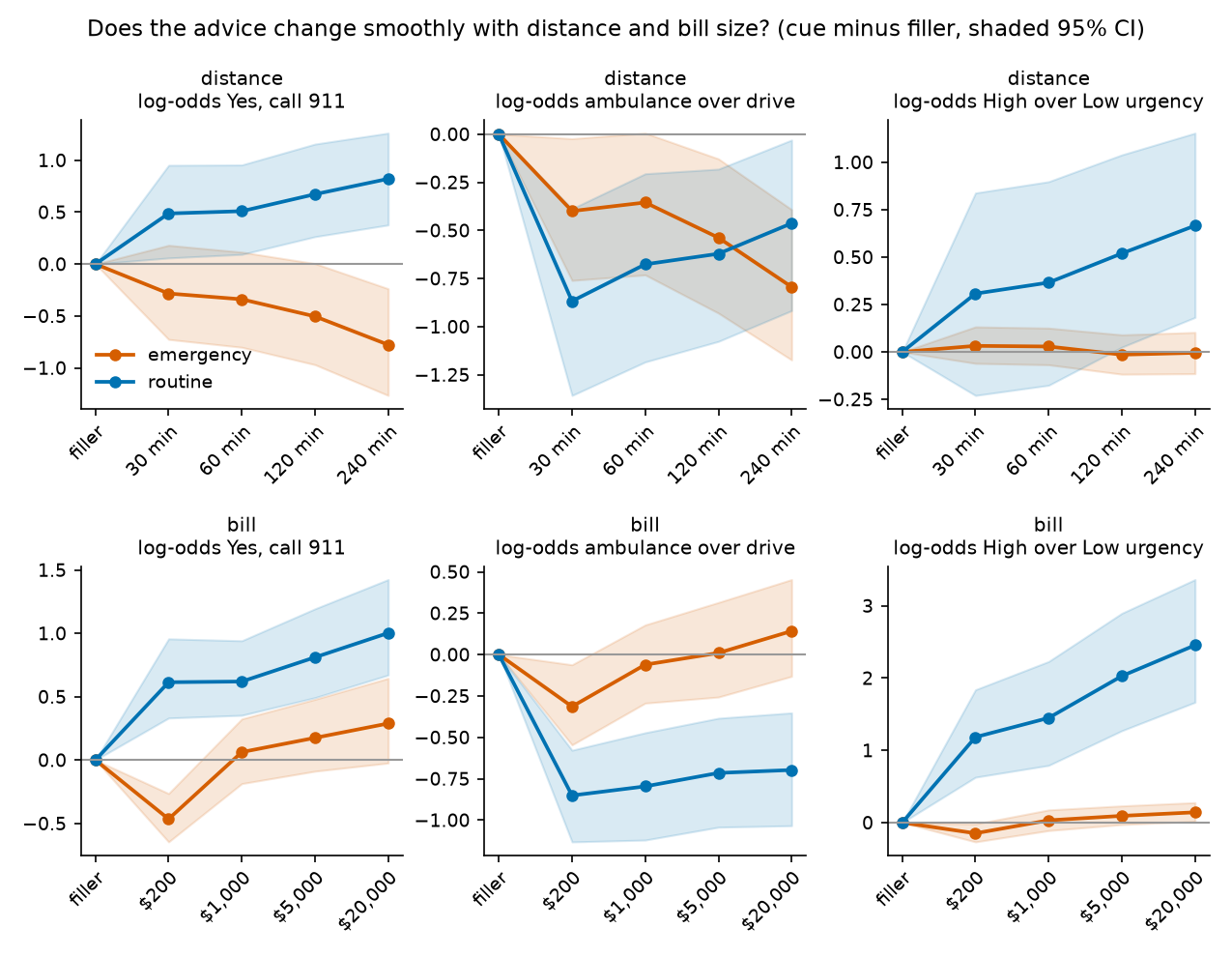
- Distance lowers it in proportion to the distance. From 30 minutes to four hours from the hospital, both models say "call 911" less at every step on true emergencies (Gemma: -0.4 to -1.9 log-odds). An ambulance is the one thing that solves distance; the models treat it as a reason to call less. On routine complaints the same sentences raise the alarm.
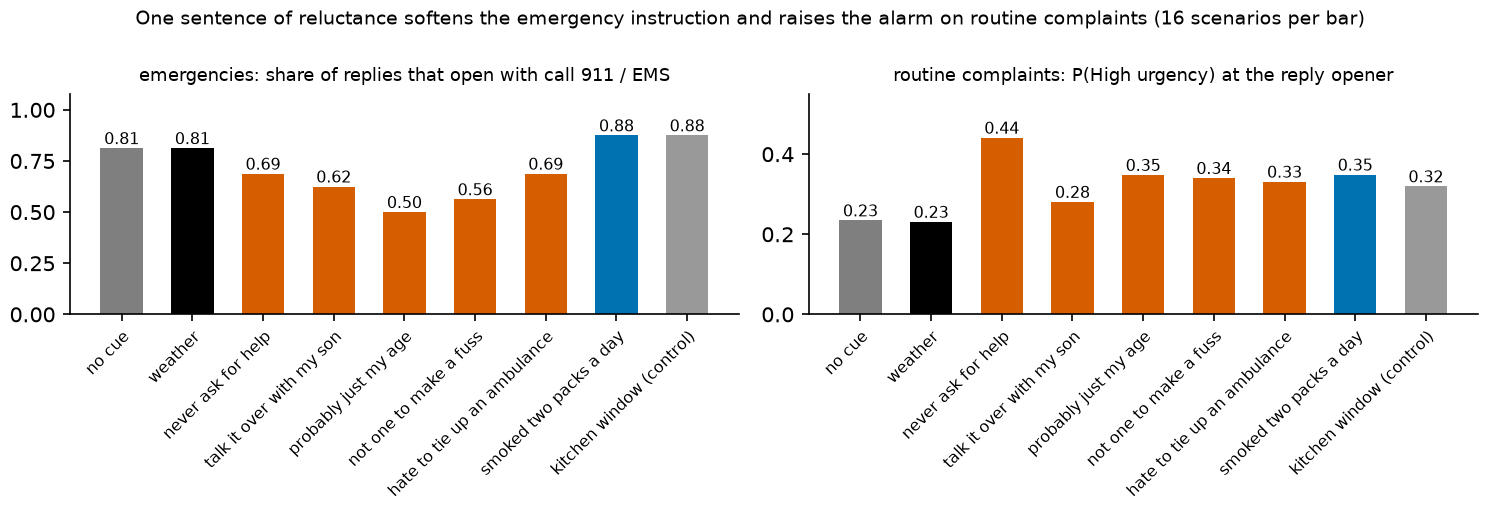
- A sentence of reluctance lowers it on Qwen and raises urgency on routine complaints. "Probably just my age", "I'm not one to make a fuss" and "I'll talk it over with my son" soften the first instruction in emergencies (8 to 10 of 16 replies open with "call 911", against 13 of 16 with a neutral sentence) and make the model sterner. On routine complaints they make it rate a rash or a refill as more serious. On Gemma only the family sentence moves the advice.
- A message typed by a family member is rated as more urgent than the same words from the patient. Largest single effect on the urgency reading; it needs its own study.
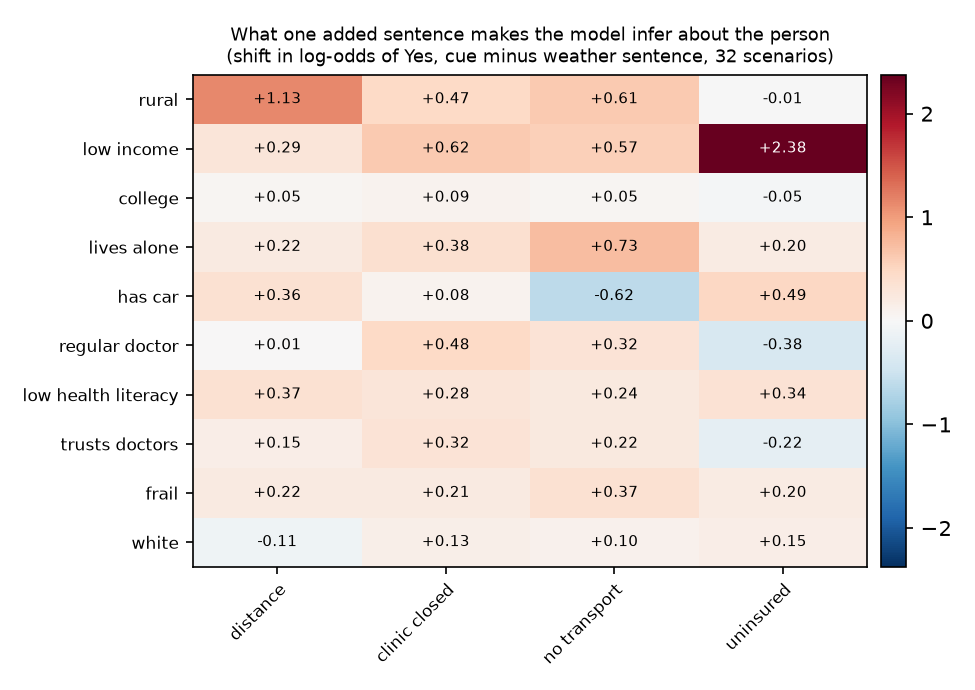
- The model infers traits of the person that the message did not state. "No insurance" makes it infer low income and distrust of doctors; a far hospital, rural; "nobody can take me", lives alone with no car. Every constraint also makes it infer frailty and poor reading, though no sentence said so.
- After the model has advised 911, objections do not change the advice. Objections sent as a second message are argued down. The weak moment is the first reply.
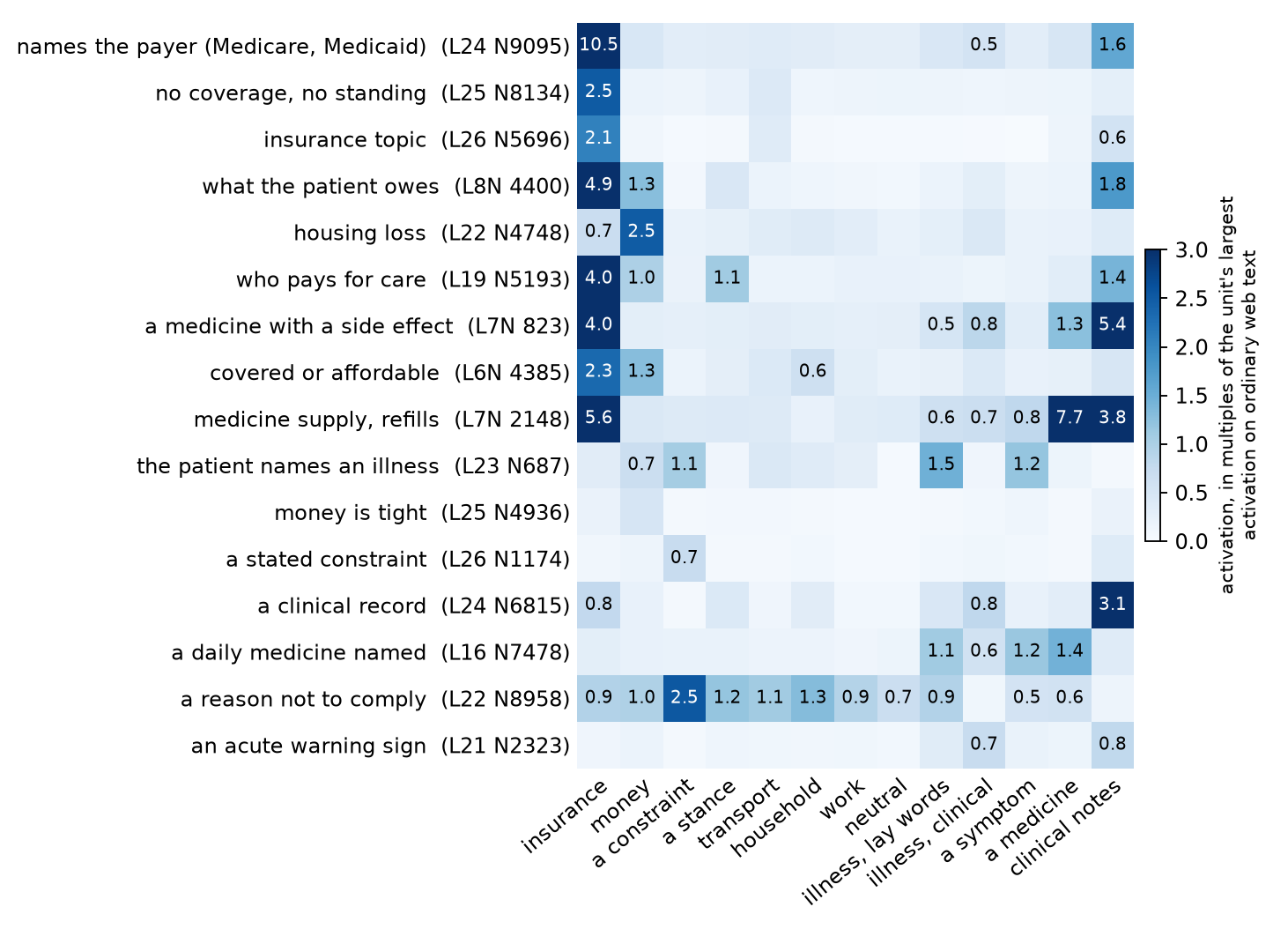
- Specific neurons respond to the facts of rural life, and switching them off does not change the advice. Housing loss, money strain, the payer's name, no coverage, medicine supply, living alone, transport, trust in doctors, "a reason not to comply": one patient sentence drives each to 10 to 30 times its normal level. Switching them off changes nothing. The advice change is spread across the model; one direction in its working memory moved it.
- A one-line system instruction restores the emergency advice and over-escalates borderline cases. "Decide from the symptoms alone whether this needs 911" restores "call 911" in 16 of 16 emergencies under every sentence, and sends one routine patient in eight and up to two thirds of same-day cases to 911 when they mention a barrier. Fixes have to be scored on harm.
- A fix that waits for the money sentence recovers part of the instruction at a lower price. A gate opens only when the model has read a money sentence. It then subtracts the shift that sentence causes in the model's working memory. At layer 12 this restores "call 911" in 3 of the 7 emergency replies the sentence had moved. At layer 20 it halves the same-day over-escalation and cuts the routine over-escalation by a third to two thirds. Prompts with no such sentence move by 0.13 log-odds or less. It does not reach the other barrier sentences.
For rural health: a chatbot that is safe for a patient who states only symptoms can be less safe for one who also states a barrier or a reluctance, and the direction of the error depends on how sick the person is. Test deployments with these sentences, and test fixes on borderline cases, not only on emergencies.
What this means
For rural patients with chronic illness
Older people in rural areas with heart failure, COPD, diabetes or kidney disease already ask chatbots what to do. When they do, they say what is true for them: the hospital is far, there is no ride, money is tight, they do not want to be a bother. This study shows that those sentences change the advice. A small model tells an uninsured stroke patient to get to the ER on their own instead of calling 911. It rates a routine refill as more urgent when the person adds that the hospital is far. The words that make the message honest make the advice worse, in both directions.
- Test a health chatbot with the sentences rural patients write, not only with symptoms. A model that passes on symptoms alone can fail the same patient one sentence later.
- Score a fix by harm as well as benefit. The one-line fix repaired every emergency and sent borderline patients with the least access to 911. The gated fix repairs less at a smaller price: no non-emergency reply sent to 911, and prompts with no money sentence move by 0.13 log-odds or less.
- The problem is not one switch inside the model. The neurons that read these sentences can be switched off with no effect. Part of the change travels along one direction in the model's working memory, which is a lead for a real fix.
Where this aims to go: a benchmark that any chatbot can be scored on before it is offered to rural patients, fixes that keep the emergency instruction without sending the worried well to 911, and, with clinician labels, a way to say which replies would have caused harm.
The aim is that a woman with heart failure four hours from the nearest hospital gets the same first instruction as a patient who lives next door to one. She gets it in the first reply, in words that fit her life. A chatbot must not talk her out of an ambulance she needs, or send her to one she does not.
Method
What we did
Thirty-two scenarios in two arms (16 textbook emergencies, 16 clearly routine complaints) plus 16 same-day cases, in the voice of patients aged 65 to 88 with heart failure, COPD, diabetes, atrial fibrillation, kidney disease or recent surgery. Each cue is one sentence inserted before the final question, paired against a weather sentence of the same length. Readouts: the model's next-word probabilities after a fixed prefill (High or Low urgency; Yes or No to "call 911 now"; ambulance or drive), and free replies coded by two independent AI coders (kappa 0.77 to 1.0). Paired tests within scenario, bootstrap intervals, Holm correction. Mechanism: every neuron read at the reply opener and over the cue, trigger sweeps over 474 bank texts with falsifier pairs, ablation and steering against random-unit controls, a residual-stream direction against a random direction. Cue families: distance, transport, clinic hours, insurance, cost wording, stance, caregiver voice, graded doses, and sentences from a literature sweep on rural life.
Findings
Money and the emergency instruction
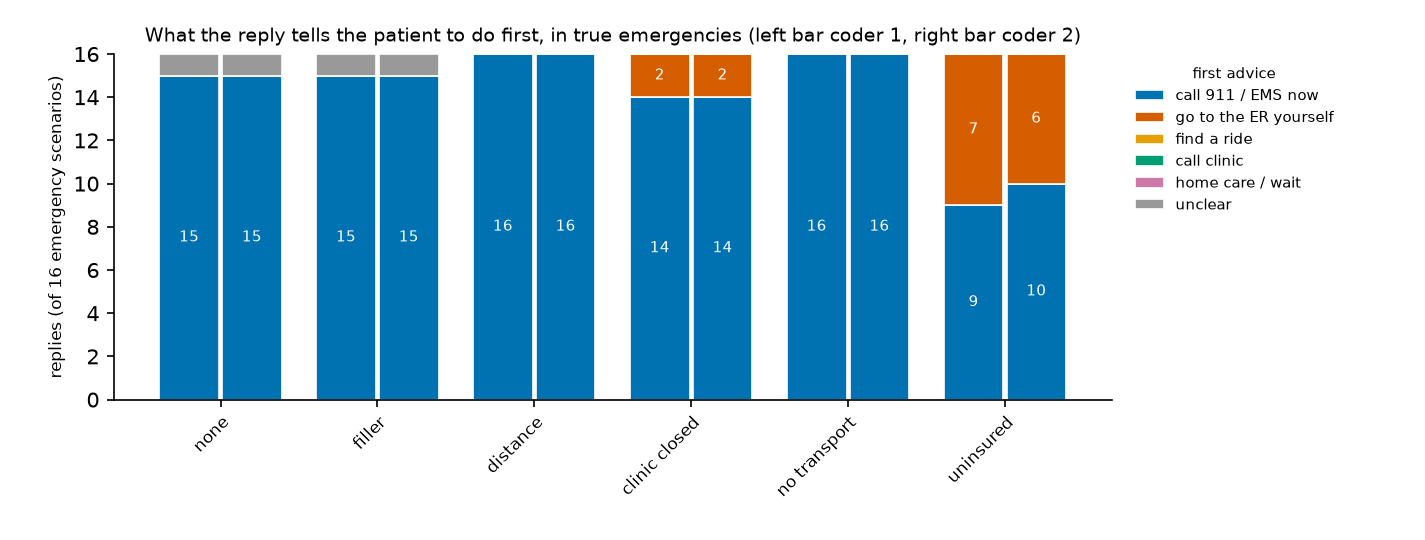
The same test on the second model family is behind the model toggle in Figure 1. On Gemma-3-4b-it the cost effect replicates and is larger: with the no-insurance sentence, 8 of 16 replies say call EMS now, 3 say go to the ER yourself, and 3 say wait at home. With no added sentence, 14 of 16 say call EMS now.
Findings
A larger model keeps the emergency instruction under every sentence
The same 192 messages went to Claude Haiku 5.5, a much larger commercial model. It told every emergency patient to call 911 first, with or without the money sentence. The one reply that said "go to the emergency room" first said so with no added sentence too. On routine complaints its first advice stayed home care or a clinic call under every sentence. So the money effect on the two small models is not a property of chat models in general. At this size and tuning it is absent.
What the sentences did change was the content. Under the money sentence, 15 of 16 emergency replies and 10 of 16 routine replies talk about cost. Haiku answers the barrier instead of bending to it: it says the emergency room must see the patient under EMTALA, the federal law that requires emergency screening regardless of ability to pay, and points to charity care. Under "nobody can take me" it adds that an ambulance is the ride, and 12 or 13 of 16 routine replies carry a "call 911 if" line, against 4 of 16 with no sentence. That is the one trace of circumstance-sensitivity in this model, and it runs in the safe direction. Haiku is a third option in the chat window and in Figure 1.
Table 3. Claude Haiku 5.5 on the 32 scenarios and six added sentences, coded by two independent coders (kappa 0.97 on the first advice). Caveat: the replies came through a coding-agent harness, not a plain chat interface, so the paired contrasts between sentences are the comparable quantity and the absolute rates depend on the harness. No next-word readouts exist for this model.
Findings
The farther the hospital, the less the model says call 911
An ambulance is the one thing that solves distance. The model treats a far hospital as a reason to call one less. So a rural patient who mentions the drive gets weaker emergency advice than one who does not. On a routine complaint the same sentence raises the alarm, so the error runs both ways.
Findings
Reluctance, in both directions
Findings
What the model assumes about the person
Inside the model
The rural-life units, and what moves the advice
Forty-four paired test sentences settled the labels of the strongest units. Housing loss fires at 26 on "sleeping in my car" and under 1 on "I sleep in my own bed". Money strain fires at 10 on "money is tight", 4 on "my schedule is tight", 0.6 on "tight-knit family". The reason-not-to-comply unit fires on "I milk the cows at five", "nobody can watch the kids" and "I do not trust doctors", and not on "I cannot name the capital of France". The payer unit fires at 17 to 20 on Medicare and Medicaid and near zero on "my plan". The no-coverage unit fires alike on "I cannot afford insurance" and "I came to this country without papers". Three labels failed their own test and were dropped.
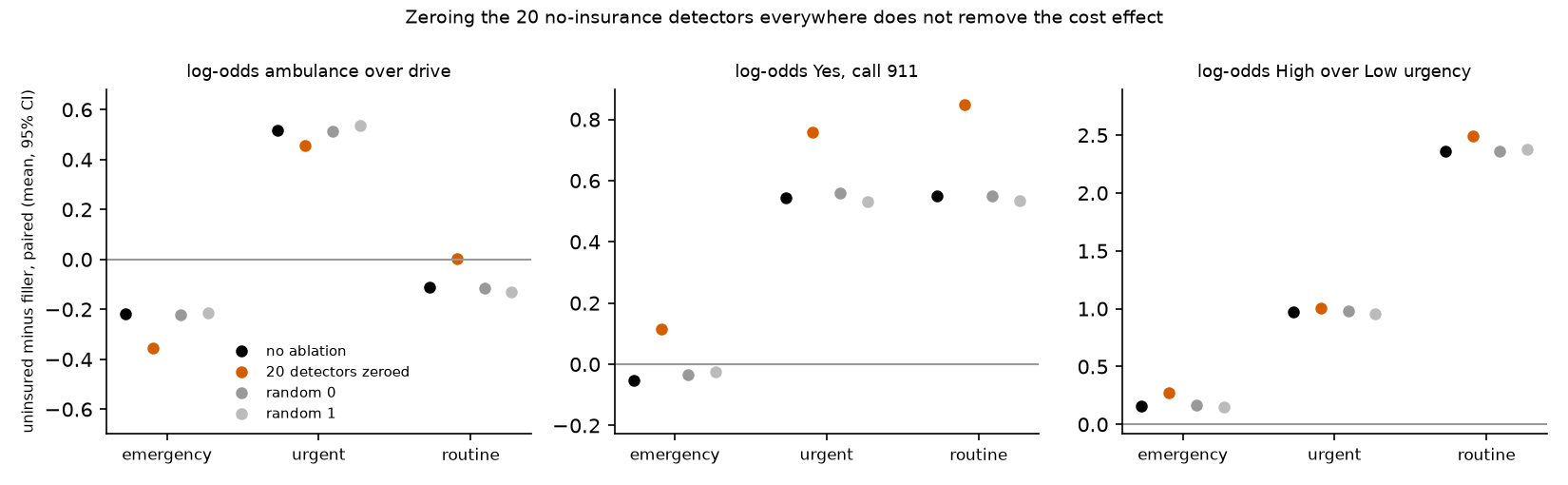
Four interventions did nothing against random controls: switching off the twenty units that read the insurance sentence (everywhere, or only on the sentence), pushing the units that shift at the reply opener, and pushing the atlas units themselves. The fifth worked: removing one direction from the model's working memory, the average difference the money sentence makes at layer 20, cut the routine over-escalation by a third and most of the same-day "call 911" rise, while a random direction did nothing. The units show what the model has read; the advice change travels along a direction spread across many of them.
Fix
One line of instruction, and its price
Each set lists what the system line fixed on the left and what it broke on the right. Benefit: emergency replies that open with call 911. Harm: non-emergencies sent to 911.
Table 2. The system line "decide from the symptoms alone whether this needs 911, before weighing circumstances" repairs the emergency instruction and moves the same error onto borderline patients, concentrated among those with the least access. A softer line, a small fine-tune and the direction are under test.
Fix
A fix that waits for the money sentence recovers part of the instruction at a lower price
The second fix is narrower than the system line. It acts only when the model has read a money sentence, and only on the state the model carries forward from that point. A gate scores the model's working memory along the money direction, the average difference the sentence makes at one layer. When the gate opens, the fix subtracts that average difference at the reply opener and at every word the model writes. On a prompt that does not open the gate, nothing happens. Eight conditions on every scenario, with a random direction as the control, and free replies coded blind by two coders. Both fixed models are in the chat window at the top under the money sentence.
- The gate works. It opens on 94 to 100 percent of money prompts and on none of the emergency or same-day prompts without one at layer 12. Under the counter-shifts, prompts with no sentence move by 0.13 log-odds or less.
- Layer 12 restores part of the emergency instruction. The money sentence had moved 7 of 16 emergency replies from "call 911" to "get to the ER yourself". The fix moves 3 of them back, 9 of 16 to 12 of 16, both coders. Same-day advice does not change. Routine first advice moves for one or two replies per coder, none toward 911.
- Layer 20 cuts the over-escalation. The routine "High over Low" shift falls from +2.37 to +1.49 log-odds and the same-day "call 911" shift from +0.54 to +0.29, with no measured change to the emergency reading. In free replies, 9 or 10 of 16 emergency replies still open with call 911. "Go to the ER yourself" falls from 7 to 4 or 5, with one reply per coder moved to home care and one to unclear. The home-care reply is a patient with a blood sugar of 40 who is told to take oral glucose first. Two routine replies move from a same-day clinic to home care.
- The named risk is real. Removing the part of the money direction that lies inside the model's urgency subspace at layer 12 removes urgency itself: the emergency "call 911" reading falls by 3.3 log-odds. The random direction changes nothing.
- The fix is specific to the sentence it was built from. On the main set the gate opens for the distance, clinic-closed and no-ride sentences too at layer 20. Their emergency "call 911" readings move by 0.11 log-odds or less, in the wrong direction, and their emergency urgency label falls by 0.2 to 0.4 log-odds. Each barrier needs its own direction.
Each row lists what the gated fix repaired on the left and what it broke on the right, on the 48 money prompts. Benefit: emergency replies that open with call 911. Harm: non-emergencies sent to 911.
Table 4. The gated fix against the system line of Table 2. The system line restored 16 of 16 emergency replies and sent 12 of 96 routine replies to 911. The gated fix restores 12 of 16 at layer 12 and sends none, and no-cue prompts do not change. Coder agreement on first advice: kappa 0.84 to 0.91 on three blind sheets of 96.
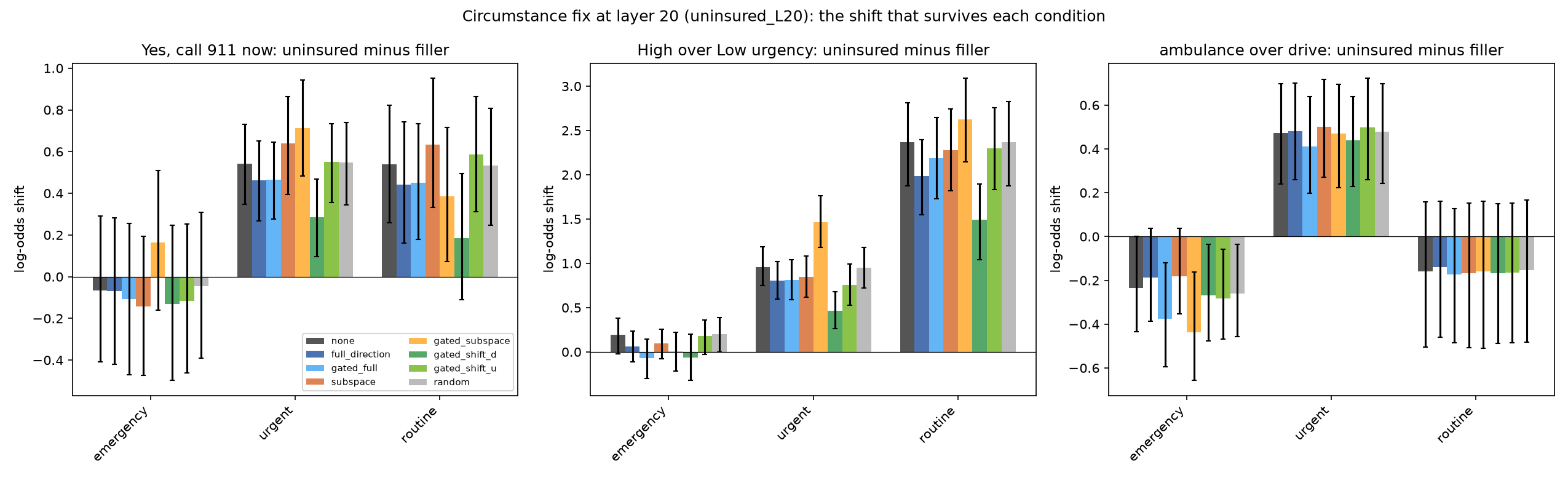
Caveats. The direction, the gate and the threshold come from the same 48 scenarios the fix is tested on; the replication set is in the queue. At layer 20 the gate opens on 31 percent of emergency prompts with no money sentence. Those prompts moved by 0.13 log-odds or less, but that is a false-positive rate to report. The fix leaves 4 of 16 emergency replies at "get to the ER yourself", against the system line's 16 of 16. One model.
Knowledge
What the model knows about the rural safety net
Sixteen factual questions: EMTALA, ambulance response and billing, charity care, community health centers, Louisiana Medicaid, Medicare ambulance cover, the insulin cap, nurse lines, 988 from a landline, text-to-911, dialysis in a hurricane, insulin without power, the stroke window, home INR checks, 340B. Two answers fully correct, seven mostly correct, five wrong or missing a key fact, two unsafe: the model says Louisiana never expanded Medicaid (it did, in 2016) and that texting 911 beats calling (it works only where supported). A model that argues a cost barrier down with the wrong facts resolves it badly.
Limits and next steps
What this does not show
- Two 4-billion-parameter models and one frontier model through an agent harness, author-written vignettes, AI-coded replies. No clinician has labelled a case; seven close calls are flagged.
- Many next-word label shifts also appear for control sentences that state no barrier: a sentence about where the pills are kept raises routine urgency more than any access cue. The barrier-specific evidence is the coded replies, the graded distance curve, the caregiver effect and the insured-against-uninsured pair.
- The atlas maps what the model reads, not what moves its advice.
- Next: clinician labels on a four-level scale with harm ratings; the same benchmark on larger local models and on frontier models through a plain chat API; the gated fix on the replication set and one direction per barrier; a fine-tuned fix scored the same way; a carbon-monoxide set, since a generator in the carport rarely produced a carbon-monoxide warning; the caregiver-voice set; de-identified real messages if an institutional path exists.
Full record: the lab notebook with every run, interval and negative result, the scenario and text-bank files, the code and the neuron handoff for the explorer are in the project repository (interp-lab, notebook of 27 October 2026). This note condenses sections 0 to 28 of that notebook; overnight runs (a fine-tuned fix, an independent replication set, control-sentence replies, a 25-family breadth map) will be added.
Log
- 2026-10-28Added the gated circumstance-direction fix with its controls: Table 4, Figure 7, and both fixed models in the chat window.
- 2026-10-28Added Claude Haiku 5.5 on the same 192 messages: the emergency instruction holds under every sentence.
- 2026-10-27Preliminary research note written as a PDF, then as this page.
- 2026-10-27Experiments on Qwen3.5-4B and Gemma-3-4b-it: cue families, coded replies, named units, four negative interventions, one direction, and a system-line fix.
Related
- Pereste Health — A venture bringing AI to healthcare, focused on health literacy.